


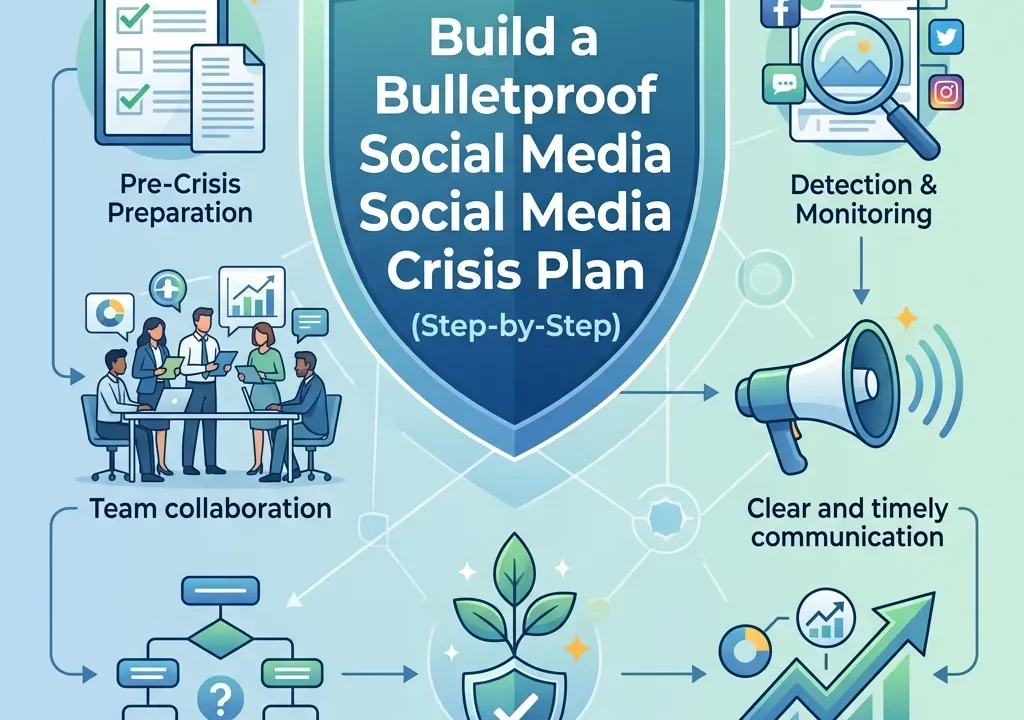
This guide explains how a social media crisis plan helps businesses prepare, respond, and recover from online disasters. It covers crisis prevention, real-time response, communication strategies, and rebuilding brand trust after reputation damage.
A single misguided tweet, a viral negative review, or a misunderstood marketing campaign can escalate into a full-blown brand disaster in a matter of hours. Social media acts as an amplifier, turning minor missteps into public spectacles. When the internet decides to turn its collective attention toward your brand’s mistake, the pressure mounts instantly.
A social media crisis is any event that negatively impacts your brand’s reputation online. It leads to a sudden surge of negative sentiment, mentions, and potential financial or reputational damage. Unlike standard customer complaints, a crisis spreads rapidly and requires immediate, strategic intervention. Having a social media crisis plan is no longer optional for businesses. It is an essential safeguard.
Without a clear strategy, teams panic, responses are delayed or poorly worded, and the damage compounds. A well-structured social media crisis plan ensures your team knows exactly what to do, who to contact, and how to communicate effectively when things go wrong. This guide breaks down the essential steps for navigating online disasters. We will cover everything from pre-crisis preparation to post-crisis recovery, ensuring your brand survives and thrives.
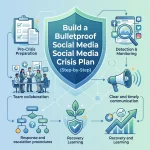
Pre-Crisis Preparation: Building a Robust Foundation
The best time to handle a crisis is before it even happens. Building a robust foundation requires foresight, clear communication protocols, and the right tools. A proactive social media crisis plan saves time, money, and stress.
Identifying Potential Crisis Scenarios

Not all crises look the same. You need to map out the specific risks your brand might face. Every social media crisis plan must account for industry-specific vulnerabilities. These generally fall into a few categories:
- Product failures or recalls: Safety hazards, broken components, or contamination.
- Public relations gaffes: Insensitive remarks from executives or controversial marketing campaigns.
- Customer service failures: Widespread shipping delays, billing errors, or unhelpful support staff.
- Inappropriate posts: Accidental tweets from the wrong account, offensive jokes, or hacked profiles.
Take time to brainstorm industry-specific risks with your team. A food and beverage company must prepare for health and safety concerns. A tech software company needs a social media crisis plan for sudden data breaches or server outages. By identifying these scenarios in advance, you can draft tailored responses and avoid starting from scratch during a high-stress situation.
Assembling Your Crisis Response Team
When a crisis hits, you cannot waste time figuring out who needs to approve a tweet. You must establish a dedicated crisis response team with clear roles and responsibilities. Your social media crisis plan should clearly outline who makes the final decisions. Your team should typically include:
- The Social Media Manager: To monitor platforms, pause scheduled content, and publish approved messaging.
- Public Relations Expert: To craft the overarching narrative, handle press inquiries, and manage the Online PR Plan.
- Legal Counsel: To review statements and ensure the company does not admit undue liability.
- Executive Leadership: To provide final sign-off on major decisions and step in as the public face if necessary.
Establish a dedicated communication channel for this team. Whether it is a specific Slack channel, a Microsoft Teams group, or an emergency text thread, everyone must know exactly where to convene when an alert goes out. Your social media crisis plan depends entirely on swift team assembly.
Developing Brand Communication Guidelines and Policies
Your brand voice might normally be witty and playful, but that tone will likely backfire during a serious product recall. Establish clear guidelines on how your Brand Communication should shift during an emergency. The tone usually needs to become empathetic, serious, and highly transparent.
Legal and compliance considerations must also be baked into your guidelines. Create a clear workflow for legal approval so statements can be vetted quickly. Additionally, update your employee social media policy. Make sure your staff knows who is authorized to speak on behalf of the company. Instruct them on what to do if they are approached by the public or the media online. A comprehensive social media crisis plan covers both external and internal messaging.
Online PR Plan and Monitoring Tools
You cannot fight a fire if you do not know it is burning. Social listening platforms are critical for catching a crisis in its infancy. Tools like Sprout Social, Brandwatch, or Hootsuite allow you to monitor brand mentions across the internet. An effective social media crisis plan utilizes these tools to catch sparks before they become infernos.
Set up keyword tracking not just for your brand name, but for common misspellings, executive names, and specific product lines. Implement sentiment analysis to alert you when the general mood around your brand suddenly shifts from positive to negative. Establish automated alerts to notify the crisis team if mention volume spikes unexpectedly.
Understanding digital public relations is vital for navigating these waters.
Read more about what is online PR and why is it important to fully grasp how digital perception shapes your business.
During the Crisis: Executing Your Response Plan
When the warning bells ring, your preparation is put to the test. Executing your social media crisis plan requires a delicate balance of speed, accuracy, and emotional intelligence. Proper Social Media Crisis Management starts the second you realize something is wrong.
Activating the Social Media Crisis Plan
The first step is verification. Before sounding the alarm, confirm that the crisis is legitimate. Is this a coordinated bot attack, a single disgruntled customer, or a genuine widespread issue? Once verified, notify the crisis response team immediately and activate the social media crisis plan.
At this exact moment, all outbound marketing must stop. Pause all scheduled social media posts, automated emails, and paid advertisements. Running a cheerful promotional ad while your brand is trending for a scandal appears tone-deaf and will only fuel the outrage. Your social media crisis plan must include an emergency “kill switch” for all marketing efforts.
Crafting Your Initial Response

Finding the balance between speed and accuracy is the hardest part of Social Media Crisis Management. If you wait too long to gather every single fact, the public narrative will form without you. If you speak too quickly without verifying the facts, you might share incorrect information and make things worse.
Utilizing Holding Statements
The solution within your social media crisis plan is the “holding statement.” This is a pre-approved, fill-in-the-blank message that acknowledges the situation and buys you time. A good holding statement shows empathy and takes ownership of the investigation.
For example: “We are aware of the issues regarding [Product/Event] and are currently investigating. We take this seriously and will provide a full update as soon as we have more information.” Choose the platform where the crisis originated to post your initial response, then amplify it across your other main channels. A strong social media crisis plan always has holding statements ready to deploy.
Developing and Disseminating Key Messages
As you gather more facts, you must transition from holding statements to factual updates. Provide clear, accurate information about what happened, what you are doing to fix it, and how it impacts your customers. Your social media crisis plan dictates how these updates are formatted and shared.
Address common concerns and questions head-on. Create a centralized hub for updates, such as a dedicated landing page on your website, and direct social media traffic there. This prevents vital information from getting buried in a fast-moving social media feed. Centralized Brand Communication minimizes confusion.
Engaging with Your Audience
People will flood your comments and direct messages with questions, complaints, and insults. Your team must know how to handle this influx. Respond to constructive questions publicly to show you are engaged and transparent. Move complex or highly personal customer service issues to private messages immediately. This is a core tenet of any effective social media crisis plan.
Know when to escalate severe threats to legal or security teams. Above all, do not argue with angry commenters. Getting defensive or snarky will only provide more screenshots for your detractors to share. Maintain a calm, professional, and helpful demeanor at all times. Social Media Crisis Management is about de-escalation.
Internal Communication
Do not leave your employees in the dark. Your staff will likely see the crisis unfolding online and may face questions from friends or clients. Keep employees informed with regular internal updates. Your social media crisis plan must prioritize the internal team just as much as the external audience.
Explain the situation, share the official public stance, and reiterate the employee social media policy. Managing internal morale is critical. A unified front helps the company navigate the turbulence more smoothly and prevents conflicting information from leaking to the press.
Post-Crisis Recovery: Learning and Rebuilding Trust
The crisis may have stopped trending, but your work is not over. The recovery phase of your social media crisis plan is about evaluating your performance, fixing broken systems, and slowly winning back your audience. Mitigating long-term Reputation Damage requires sustained effort.
Analyzing Reputation Damage and Reporting
Once the dust settles, conduct a thorough post-mortem. Measure the impact of the crisis by analyzing metrics like lost followers, negative mention volume, and any dips in sales or website traffic. This data helps you quantify the Reputation Damage and adjust your social media crisis plan.
Analyze the effectiveness of your response. Did the team assemble quickly enough? Were the holding statements effective? Did the legal approval process cause unnecessary delays? Gather feedback from stakeholders, including the social media managers who were on the front lines, to understand what worked and what failed.
Reviewing and Updating Your Social Media Crisis Plan
A social media crisis plan is a living document. Use the insights gained from your post-mortem to identify lessons learned. Modify your processes and policies accordingly to improve your overall Social Media Crisis Management strategy.
If your social listening tool failed to catch the initial spark, it might be time to update your keywords or switch platforms entirely. If the approval workflow was too slow, simplify the chain of command for the next emergency. A good social media crisis plan evolves after every incident.
Rebuilding Brand Reputation

Trust is lost in buckets and rebuilt in drops. Focus on proactive Brand Communication and transparency. If you promised to change a policy or fix a product defect during the crisis, document that process publicly. Show your audience that you are keeping your word.
Invest heavily in customer service and relationship management. Go above and beyond to delight the customers who stuck with you. Over time, showcase positive changes, highlight community initiatives, and slowly return to your normal content strategy. Keep a close eye on audience reception to ensure your Reputation Damage is healing.
Employee Training and Preparedness
Crisis management skills degrade if they are not used. Conduct regular drills and simulations with your response team to keep your social media crisis plan sharp. Create mock scenarios and test how quickly the team can draft a holding statement and get it approved.
Continuing education on Social Media Crisis Management ensures that when the next storm hits, your team relies on muscle memory rather than panic. Make reviewing the social media crisis plan an annual mandatory training exercise for all relevant staff.
Social Media Crisis Management Comparison
To better understand how to execute your social media crisis plan, it helps to compare proactive versus reactive strategies.
|
Strategy Type |
Focus Area |
Resource Investment |
Outcome |
|---|---|---|---|
|
Proactive (Pre-Crisis) |
Drafting a social media crisis plan, setting up listening tools |
High initial time investment, low stress |
Fast response, minimized Reputation Damage |
|
Reactive (Mid-Crisis) |
Scrambling for approvals, arguing in comments |
Low initial investment, high stress |
Delayed response, maximum Reputation Damage |
|
Recovery (Post-Crisis) |
Apologizing, updating the Online PR Plan, retraining staff |
Sustained effort over months |
Slow rebuild of trust and brand loyalty |
Case Studies and Best Practices
Looking at real-world examples helps solidify these concepts. It highlights the stark difference between a good and bad social media crisis plan.
Successful Social Media Crisis Management
A prime example of effective Social Media Crisis Management is KFC’s handling of their 2018 chicken shortage in the UK. Supply chain issues forced hundreds of stores to close. Instead of offering corporate excuses, KFC utilized a brilliant Online PR Plan.
They took out a full-page newspaper ad showing an empty bucket with the letters rearranged to spell “FCK.” The accompanying text apologized sincerely and humorously. They owned the mistake, showed empathy, and utilized a dedicated webpage for real-time updates. The public praised their transparency. Their social media crisis plan worked perfectly.
Botched Crisis Management
Conversely, United Airlines faced massive Reputation Damage when a passenger was forcibly dragged off an overbooked flight. The initial response from the CEO described the incident as having to “re-accommodate” customers. This sterile Brand Communication lacked empathy and completely minimized the physical violence captured on viral videos.
The tone-deaf response fueled massive outrage, tanked the company’s stock, and forced the CEO to issue multiple, increasingly apologetic statements over several days. They clearly lacked an empathetic social media crisis plan.
Safeguard Your Future
Navigating the unpredictable digital landscape requires more than just good luck; it requires meticulous preparation. A social media crisis plan empowers your team to act swiftly, communicate transparently, and protect your brand’s hard-earned reputation when disaster strikes.
Without a social media crisis plan, a minor issue can become a permanent scar on your digital footprint. By anticipating risks, assembling a dedicated team, and prioritizing empathetic Brand Communication, you can turn a potential disaster into a demonstration of your brand’s integrity. Take the time today to develop or review your social media crisis plan. Your future self will thank you.
Frequently Asked Questions
What exactly is a social media crisis plan?
A social media crisis plan is a documented strategy detailing how a business will respond to online emergencies. It outlines specific team roles, pre-approved holding statements, and protocols for pausing regular marketing content. Having this plan prevents panic and ensures a unified, rapid response to minimize Reputation Damage.
Why is Social Media Crisis Management so important today?
Social media amplifies mistakes globally within minutes, meaning minor issues can escalate into massive brand disasters almost instantly. Proper management allows companies to control the narrative, demonstrate accountability, and prevent permanent Reputation Damage. It acts as an insurance policy for your brand’s public image.
How quickly should a company respond to a crisis online?
Companies should aim to issue a brief holding statement within the first hour of a verified crisis breaking online. This initial response acknowledges the issue and buys the team time to investigate without leaving a communication vacuum. Speed is critical to effective Brand Communication during emergencies.
Who should be included in the crisis response team?
Your response team should include the primary social media manager, a public relations or corporate communications expert, and a legal advisor. You also need an executive leader capable of giving final sign-off on major public statements. This ensures all messaging is legally sound and aligns with your Online PR Plan.
What is a holding statement in a social media crisis plan?
A holding statement is a pre-drafted, fill-in-the-blank message used to acknowledge an emerging issue immediately. It shows the public that you are aware of the problem and are actively investigating it before all the facts are known. This prevents the brand from appearing silent or indifferent.
How do we know if a negative comment is an actual crisis?
A single negative comment is a customer service issue, but a crisis involves a sudden, massive spike in negative sentiment and mention volume. If the issue has the potential to cause significant financial loss, legal trouble, or severe Reputation Damage, it is a crisis. Monitoring tools help identify this volume spike.
Should we delete negative comments during a crisis?
No, you should never delete negative comments unless they contain hate speech, severe profanity, or doxxing. Deleting legitimate criticism looks like a cover-up and will enrage the internet further, exacerbating your Reputation Damage. Instead, respond professionally and move complex issues to private messaging.
Why must we pause scheduled posts during a crisis?
If you are dealing with a severe public scandal, an automated post promoting a weekend sale will make the brand look incredibly tone-deaf and disconnected. Pausing all scheduled content ensures that your sole focus—and your audience’s focus—remains on resolving the immediate issue with appropriate Brand Communication.
How does an Online PR Plan help with post-crisis recovery?
An Online PR Plan helps rebuild trust by strategizing how to communicate corrective actions and positive brand stories after the dust settles. It focuses on pushing transparent updates, securing positive media coverage, and slowly repairing the brand’s image. This is a crucial step in reversing Reputation Damage.
How often should we update our social media crisis plan?
You should review and update your social media crisis plan at least once a year, or immediately following any actual crisis event. Updating the plan ensures contact information is current, new platform features are accounted for, and lessons learned are integrated. Regular drills also help keep the team prepared.


I’m a communication strategist and blogger at SMCrisis, where I cover topics on social media crises, digital reputation, and brand trust. I enjoy helping businesses stay prepared and proactive in the fast-changing online world. Every post I write aims to guide readers toward smarter crisis responses and stronger digital credibility.








No Comments