


A well-crafted press release turns announcements into news by focusing on clarity, relevance, and structure. Strong headlines, concise facts, and strategic distribution help secure media coverage, boost credibility, and support social media marketing success.
A well-designed Press Release can convert your commercial announcement into front-page news. Most press releases never see daylight, burying hundreds of forgotten pitches in the grave of journalists’ inboxes. The difference between success and ambiguity often comes down to understanding what journalists actually notice. You must know what makes them read your pitch and what makes them delete it.
The media release remains one of the most powerful tools in your PR arsenal when you execute it correctly. They generate valuable media coverage, increase brand reliability, and reach thousands of potential customers. Modern journalists receive dozens of press releases per day, and they spot amateur efforts instantly. You need a competitive edge to stand out in this crowded space.
This guide walks you through the essential elements of writing a media release that journalists will actually read, publish, and share. You will learn how to frame your announcement, craft convincing headlines, and avoid common errors. Whether you are launching a product, boosting your social media marketing, or managing a social media crisis, this guide provides the exact blueprint you need.
What Makes a Press Release Effective?
An effective media release serves two distinct masters. It serves the journalists searching for compelling stories, and it serves the ultimate target audience. The best Press Release presents valuable information in a format that journalists can easily adapt for their publications. You must deliver the facts clearly and concisely.
Journalists evaluate a Press Release based on absolute news value, reliability, and clear purpose. They ask themselves if the story holds relevance for their specific audience. They question if they can trust the source and if they can confirm the information easily. Your media release must answer these questions immediately.
The most successful media release campaigns follow strict journalism standards. They highlight unique angles that make the story truly worth covering. They provide enough details to understand the story without overwhelming busy journalists with unnecessary marketing fluff.
- Relevance: Connect your news to current industry trends.
- Brevity: Keep the content punchy and direct.
- Formatting: Use standard structures that reporters expect.
- Accessibility: Provide clear contact details and media assets.
Remember that journalists do not want free advertisements. They want legitimate news that sparks interest among their readers. Keep your focus on the newsworthy aspects of your announcement instead of using heavy campaign language.
Essential Elements of a Strong Press Release
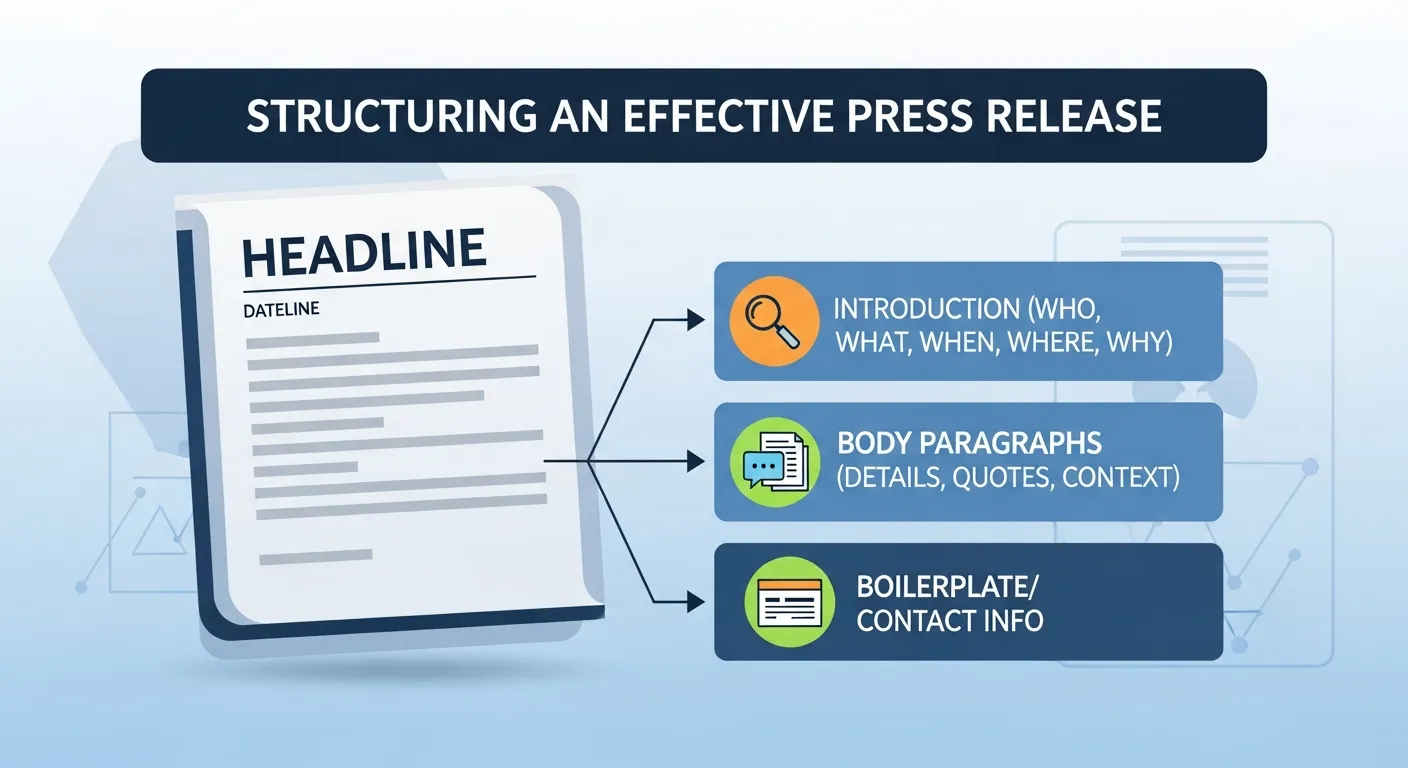
Every great media release relies on a standardized, proven structure. Mastering these elements ensures your news gets the attention it deserves.
The Headline That Hooks
Your headline determines whether journalists will read beyond the very first line. Effective headlines remain specific, highly newsworthy, and strictly under 70 characters. This length ensures they display properly in email subject lines and digital news feeds.
Strong headlines focus entirely on the most newsworthy aspect of your announcement. Instead of “Company X Launches New Product,” write “Company X’s AI Tool Reduces Customer Service Response Time by 75%.” The second headline instantly tells journalists why their readers should care.
Use active voice and strong verbs to create urgency. Avoid dense industry jargon that might confuse journalists unfamiliar with your specific field. Your headline should remain understandable to a general audience while highlighting a specific benefit.
The Lead Paragraph
Your first paragraph must answer the five W’s and one H: Who, What, When, Where, Why, and How. You must present this crucial information in order of importance. Always place the most newsworthy elements first to hook the reader immediately.
The lead paragraph should contain no more than 35 words. Busy journalists need to understand your story immediately without digging through multiple paragraphs. Give them the core facts right away.
Start with your absolute most compelling news angle. If you announce a partnership that creates 500 new jobs, lead with the job creation. Avoid starting with generic phrases like “We are pleased to announce.”
Supporting Details and Context
The second and third paragraphs expand on your lead with necessary context. You provide background information and critical supporting details here. This section explains exactly why your news matters and how it fits into larger industry trends.
Provide highly specific data, statistics, or concrete examples that support your main announcement. If you launch a new service, include hard data about market research and customer demand. If you manage a social media crisis, detail the exact steps you are taking to resolve the issue.
Keep these paragraphs short and tightly focused on single topics. Journalists often cut content to fit their publication’s space requirements. Well-organized, scannable paragraphs make the editing process much easier. Read more on press release basics
Compelling Quotes
Quotes inject crucial human interest into your media release. They provide journalists with ready-made, copy-paste content for their articles. Always include quotes from key stakeholders like company executives, strategic partners, or actual customers.
Effective quotes go far beyond generic corporate enthusiasm. They provide specific insights, clear explanations, or bold industry predictions. Instead of “We love this new product,” write “This technology solves a problem that has frustrated our users for a decade.”
Use quotes to provide emotional context that might not fit naturally in the factual main text. Keep quotes highly conversational and authentic. Avoid robotic corporate speak that doesn’t sound like natural human dialogue.
Contact Information and Resources
End your Press Release with crystal clear contact information for media inquiries. Include names, direct phone numbers, and professional email addresses. Consider providing multiple contacts in case your primary spokesperson becomes unavailable during breaking news.
Add a brief company boilerplate at the very bottom. This standard paragraph provides background information about your company’s founding date, core mission, and notable achievements. Journalists use this for context.
Include links to relevant digital resources. Link to high-resolution images, video product demos, or extended executive biographies. Make it incredibly easy for journalists to find everything they need. Explore a comprehensive press release guide
The Role of a Press Release in Social Media Marketing
A Press Release does not just live on news websites. It plays a massive role in your broader social media marketing strategy. When a publication picks up your Press Release, you can leverage that earned media across all your social channels.
Sharing published articles validates your brand to your social media followers. It acts as powerful third-party social proof. A strong media release strategy feeds your social media marketing content calendar with high-quality, authoritative updates.
You can also optimize your media release for search engines and social sharing. Include tweetable quotes and highly engaging multimedia assets. When you integrate your Press Release distribution with your social media marketing, you multiply your overall reach exponentially.
Press Release vs. Social Media Marketing Post
|
Feature |
Press Release |
Social Media Marketing Post |
|---|---|---|
|
Primary Audience |
Journalists, Editors, Investors |
Direct Consumers, Followers |
|
Tone |
Objective, Factual, Professional |
Conversational, Engaging, Casual |
|
Format |
Standardized text, 400-800 words |
Short text, highly visual |
|
Goal |
Earned media coverage |
Direct engagement and sales |
Using a Press Release During a Social Media Crisis
When a social media crisis strikes, a Press Release becomes your most critical defense tool. Social platforms move too fast and limit your ability to explain complex situations. A formal Press Release allows you to reclaim the narrative and state the verified facts clearly.
During a social media crisis, reporters will actively look for an official statement. Publishing a Press Release ensures that journalists quote your actual words, rather than pulling unverified tweets from angry users. It shows that your leadership team takes the situation seriously.
Your crisis Press Release should acknowledge the issue immediately and take appropriate responsibility. Outline the exact steps your company is taking to fix the problem. Transparency and speed remain your best weapons against a spiraling social media crisis.
Common Press Release Mistakes to Avoid
Many press releases fail spectacularly because they read exactly like sales advertisements. You must fiercely avoid promotional language, excessive superlatives, and wild claims that you cannot verify. Journalists identify marketing copy instantly, and it destroys your professional credibility.
Do not bury your actual news deep in company history. Lead with your most newsworthy information at the top. Journalists have incredibly limited time, and they need to grasp your story within three seconds of opening your email.
Avoid sending a Press Release for minor, routine business activities. Save this powerful tool for genuinely newsworthy announcements. If you spam journalists with trivial updates, they will block your email address permanently.
Timing and Distribution Strategy

Timing heavily dictates the success of your Press Release. Tuesday through Thursday represent the best days for distribution. Journalists remain highly active and focused during the middle of the business week. Avoid sending news on Monday mornings or late Friday afternoons.
While planning your announcement, research the industry’s specific news cycle. Business publications often run specific themed sections that match certain types of news. Timing your Press Release to align with these editorial calendars dramatically increases your chances of coverage.
Distribute your Press Release through multiple reliable channels. Use a professional wire service, pitch directly to relevant journalists, and post it on your company’s official newsroom. Syndicate the news through your social media marketing channels to maximize visibility.
Measuring Press Release Success
Track both the immediate and long-term results of your Press Release efforts. Immediate metrics include direct media pickups, sudden website traffic spikes, and social media marketing engagement. Long-term benefits include improved brand awareness and sustained lead generation.
Monitor exactly where your Press Release gets published and how journalists adapt your original content. This data helps you refine your approach for future releases. It also identifies which specific media outlets respond best to your brand.
Pay close attention to the types of stories that generate the most inbound interest. This vital insight helps you identify compelling newsworthy angles for the future. Use this data to constantly improve your overarching PR and social media marketing strategy.
Building Long-Term Media Relationships
Successful press releases act as the foundation for broader media relationship building. Consistently providing highly valuable, newsworthy content establishes your company as a reliable source. Journalists love working with professionals who make their jobs easier.
Respond promptly and helpfully to all journalist inquiries. Build a reputation as a responsive, knowledgeable industry source. This goodwill directly leads to future, unprompted coverage opportunities.
Consider offering exclusive early access to journalists who consistently cover your industry fairly. These deeper relationships often result in massive, in-depth feature articles. Treat journalists as valuable business partners rather than just distribution channels.
Frequently Asked Questions (FAQ)
1. How long should a standard Press Release be?
A standard Press Release should be between 400 and 800 words. Keep it concise and focused entirely on the core news. If you exceed 800 words, you risk losing the journalist’s attention and burying the main point.
2. How does a Press Release help after a digital hack?
When malicious actors compromise your accounts, public panic ensues quickly. Releasing an official statement helps you control the narrative. Reviewing a social media security breach guide ensures you include all necessary legal and technical reassurances in your Press Release.
3. Should we include images in our Press Release?
Yes, you should absolutely include links to high-resolution images, company logos, or product photos. Providing visual assets makes it much easier for journalists to publish your story immediately without requesting additional files.
4. What is a boilerplate in a Press Release?
A boilerplate is a short, standardized paragraph at the end of the Press Release that describes your company. It includes your mission, founding date, and website link. It provides journalists with quick background context about your organization.
5. How do we prepare a media release for an online backlash?
Preparation requires having pre-approved templates ready before a disaster strikes. Following established social media crisis management best practices ensures your crisis Press Release strikes the right tone, accepts appropriate responsibility, and outlines clear corrective actions.
6. Can a Press Release improve our SEO?
Yes, a well-distributed media release can generate high-quality backlinks from reputable news sites. These authoritative backlinks significantly boost your website’s search engine ranking and overall digital visibility.
7. When is the absolute worst time to send a Press Release?
You should never send a media release on Friday afternoon, weekends, or major national holidays. Journalists are either finishing their shifts or off the clock, meaning your news will get buried and ignored.
8. What triggers the need for a crisis Press Release?
Major triggers include product recalls, executive scandals, or deeply offensive marketing campaigns that spark public outrage. Understanding the common causes of social media crisis events helps your PR team draft responsive releases before the situation spirals out of control.
9. How do we integrate a Press Release with social media marketing?
Once a publication picks up your Release, share that third-party article across your social media channels. You can also pull powerful executive quotes from the release and turn them into engaging graphic posts for your followers.
10. Should we use an expensive wire service for distribution?
Wire services guarantee broad syndication across hundreds of news sites and search engines. However, combining a wire service with highly personalized, direct email pitches to specific journalists always yields the highest quality media coverage.


I’m a passionate digital strategist and content creator focused on crisis communication, social media management, and online reputation. At SMCrisis, I share insights, tips, and real-world strategies to help brands navigate challenges, protect their image, and build trust in the digital space. My goal is to make crisis management simple, smart, and actionable for every business.









No Comments